How to Choose a Smart Watch Supplier in 2026?
Table of Contents
- Size the Opportunity Using IDC’s 534.6M Wearable Shipments in 2024
- Stress-Test Demand Against Counterpoint’s 7% Smartwatch Shipment Drop in 2024
- Audit Factory Quality Systems and Capacity Against ISO 9001 and ISO 13485
- Verify Battery and Wireless Compliance with IEC 62133-2 and Bluetooth SIG
- Compare MOQ, Lead Time, Yield, and Pilot KPIs Before Selecting a Supplier
- FAQS
- Conclusion
Choosing a smart watch supplier in 2026 means looking beyond a polished product photo. A watch may shine under showroom lights, yet struggle with battery life, screen response, or stable app connections. Steve Jobs once said, “Design is not just what it looks like and feels like. Design is how it works.” That principle matters when comparing wearable devices and the suppliers behind them.
A dependable supplier should explain how its team tests each model, manages component changes, and handles defects after delivery. Ask to inspect a working sample. Check whether the heart-rate readings remain consistent during ordinary exercise, whether the strap feels comfortable after several hours, and whether the charging pins align cleanly. Small details tell a story.
Numbers matter, too. Request clear specifications for battery capacity, display type, supported phone systems, and production lead times. Ask for relevant quality records and a written warranty. Then compare the answers with the sample in your hand. Promises are easy. Proof takes effort.
There is no perfect supplier. Even established factories can face delays or component shortages, and a glossy sample may not represent every production batch. That is worth remembering. This guide explores practical ways to assess a smart watch supplier, from technical capability and communication to sample testing and after-sales support. The goal is not to find the cheapest quote at any cost. It is to find a partner whose claims hold up when real orders begin.
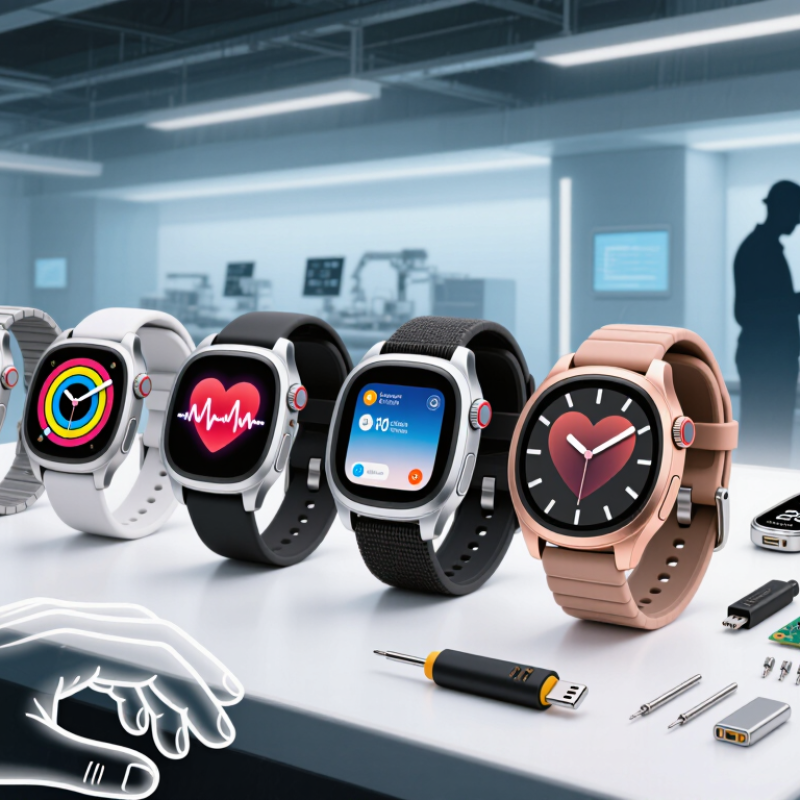
Size the Opportunity Using IDC’s 534.6M Wearable Shipments in 2024
How to Choose a Smart Watch Supplier in 2026?
Size the Opportunity Using IDC’s 534.6M Wearable Shipments in 2024
IDC recorded 534.6 million wearable-device shipments worldwide in 2024, up 6.1% year over year, according to its Worldwide Quarterly Wearable Device Tracker. That total includes hearables, wristbands, and other devices—not just smartwatches. Treat it as market scale, not a purchase order.
Counterpoint Research reported that global smartwatch shipments fell 7% in 2024 in its Global Smartwatch Shipments Tracker. That distinction matters. Broad wearable growth can hide weakness in a specific category, so suppliers should be assessed against your intended product and customer.
Ask potential suppliers for model-level minimum order quantities, production lead times, monthly capacity, and recent batch defect rates.
Request a sample and record battery life, heart-rate readings, GPS performance, and app syncing over several days.
A polished demo proves little. Check the battery-test conditions, too: screen brightness and notification frequency can change results. Compare firmware support, component traceability, repair options, and spare-part availability before focusing on unit price.
IDC’s shipment figure signals a large ecosystem, but reachable demand depends on use case, sales channel, and product fit. Forecasts can sound precise; SKU-level sell-through is still uncertain.
Stress-Test Demand Against Counterpoint’s 7% Smartwatch Shipment Drop in 2024
A reported 7% decline in smartwatch shipments during 2024 should shape supplier checks in 2026. It does not prove that demand will keep falling. It does make optimistic forecasts worth testing. Ask suppliers to model a slower quarter, not just a smooth production ramp. What happens if sell-through lands 15% below plan? Can orders be reduced without leaving you with thousands of finished watches in storage?
Shipment figures are not a perfect measure of consumer demand. Inventory corrections and regional product mix can also affect them. Request separate scenarios for steady, moderate, and weak sales, with assumptions stated clearly. Then compare minimum order quantities, component lead times, and fees for changing a production run. Ask for a sample schedule showing when the display, battery, casing, and packaging must be ready. Details matter.
A polished forecast can still be wrong. That is worth admitting. Test the supplier’s response to a delayed launch or slower reorder, and get the agreed adjustment terms in writing. Check quality records from recent production batches, not only a showroom sample. A supplier that explains capacity limits plainly may be safer than one promising instant flexibility. Leave room for uncertainty in your first order, even if the unit price looks less attractive.
| Evaluation Dimension | Market Context or Buyer Target | Evidence to Request from Supplier | Demand Stress Test | Suggested Weight |
|---|---|---|---|---|
| Demand resilience | Global smartwatch shipments declined 7% year over year in 2024. Use this as a downside-planning reference, not as a forecast for your own product or sales channel. | Capacity plans, production lead times, minimum order quantities, and written terms for changing or postponing orders. | Set the prior-year plan to 100 units, then test whether the supply plan remains workable at 93 units. Also model a more severe decline using your own risk assumptions. | 20% |
| Order flexibility | Suggested buyer target: confirm practical options for smaller initial orders, staged releases, and changes to future orders before production starts. | Quotation showing minimum order quantity by model, color, and configuration; order-change deadlines; cancellation terms; and any related fees. | Compare the cost and delivery impact of ordering 100 units at once versus releasing 93 units in stages. | 15% |
| Production capacity and continuity | Capacity should be verified for the specific product configuration and requested delivery window—not inferred from a general factory capacity claim. | Production schedule, capacity allocation, component sourcing plan, and a documented response plan for delays or supply interruptions. | Ask for a revised production plan after a 7% order reduction and for a separate plan if a critical component is delayed. | 15% |
| Product quality and reliability | Set acceptance criteria before sampling. Define how defects, inspection, rework, and replacement units will be handled. | Product specification, sample units, inspection checklist, test records relevant to the device, and written defect-remedy terms. | Check whether quality controls and traceability remain consistent across pilot and repeat orders, including smaller production runs. | 15% |
| Compliance and claims | Requirements depend on destination market, radio functions, battery design, and product claims. Verify applicable rules before placing an order. | Current, model-specific test reports and declarations applicable to the intended markets; supporting evidence for water-resistance and health-related claims. | Confirm that certificates and reports cover the exact model and hardware configuration being quoted, including any requested revisions. | 10% |
| Software and device compatibility | Confirm supported phone operating systems, app functions, language coverage, update process, and ownership of any custom work. | Working demonstration, compatibility list, software-update policy, issue-response process, and written terms for app or firmware changes. | Test the core customer journey with representative phones and verify who handles software support after delivery. | 10% |
| Warranty and after-sales support | Agree on support responsibilities and remedies before purchase; warranty coverage and consumer obligations vary by contract and market. | Written warranty terms, spare-parts availability, repair or replacement process, response times, and escalation contacts. | Ask how the supplier would handle a support-volume increase or replacement request if sales are below plan and inventory ages. | 10% |
| Cost and commercial transparency | Compare total landed cost rather than unit price alone. Include tooling, packaging, testing, shipping, duties, and order-change costs where applicable. | Itemized quotation, payment schedule, Incoterms, tooling ownership terms, and a clear list of potential extra charges. | Recalculate landed cost for both the 100-unit baseline and the 93-unit downside case, including any minimum-order or rescheduling fees. | 5% |
| How to use this scorecard: The 2024 shipment decline is the market reference; the suggested weights, buyer targets, and stress-test steps are procurement planning recommendations, not published industry standards. Score each supplier against the same evidence and product requirements. | ||||
Audit Factory Quality Systems and Capacity Against ISO 9001 and ISO 13485
A smartwatch supplier’s certificate matters only when its scope matches the factory, products, and processes you will use.
Request current ISO 9001 and, where medical-device requirements apply, ISO 13485 certificates. Check the site address, scope, expiry date, and issuing certification body.
ISO 9001 covers quality management broadly; ISO 13485 sets requirements for quality systems in medical-device contexts.
Neither certificate proves every watch is accurate or every batch is defect-free. Paper is not production.
Capacity deserves equal scrutiny.
IDC reported 534.6 million global wearable-device shipments in 2024, up 6.1% year over year. That market figure is not proof that a specific factory can meet your forecast.
Review recent defect and corrective-action records, calibration logs, supplier controls, staffing, and equipment downtime. Then observe a pilot run: compare actual cycle times, first-pass yield, and rework with the supplier’s promised monthly output.
Ask how a sudden order increase would affect inspection and traceability. A short audit can miss seasonal labor changes or subcontracted steps; that limitation is easy to overlook.
Check again.
Verify Battery and Wireless Compliance with IEC 62133-2 and Bluetooth SIG
When choosing a smartwatch supplier in 2026, ask for battery evidence tied to the exact model you plan to buy. IEC 62133-2 covers safety requirements and tests for portable sealed rechargeable lithium cells and batteries. Request the full test report, not just a certificate image. Check that it identifies the cell or battery configuration, model number, and applicable standard edition. Small details matter. A changed cell, protection circuit, or pack layout may make an older report less relevant.
Then compare the tested design with a production sample. Look for clear labeling, secure battery placement, and no swelling or loose wiring. Ask how the supplier controls changes between tested and shipped units. A polished PDF cannot answer that question. This check is easy to rush, and that is a real weakness in many sourcing reviews.
For wireless compliance, verify the smartwatch’s Bluetooth SIG qualification record and confirm that it matches the model and Bluetooth implementation being offered. Ask whether the design or product has been qualified for its intended role, and request supporting records. Qualification does not prove strong range, stable syncing, or good battery life; those need practical testing. Try pairing the watch with common phones, then check reconnection after a brief disconnect. One awkward gap can remain: supplier documents may be accurate while the sample behaves differently, so retain test samples and record the results.
Compare MOQ, Lead Time, Yield, and Pilot KPIs Before Selecting a Supplier
How to Choose a Smart Watch Supplier in 2026?
Compare MOQ, Lead Time, Yield, and Pilot KPIs Before Selecting a Supplier
Choosing a smartwatch supplier in 2026 takes more than comparing unit prices. Ask for the minimum order quantity in writing, including packaging and accessory requirements. A low MOQ can help test demand, but setup fees may raise the real cost per unit. Small details matter. Request a sample quote at two order volumes.
Compare the quoted lead time with a dated production schedule. Clarify when the clock starts: after deposit, component approval, or final specification sign-off. Yield should mean usable units that pass agreed inspection, not simply completed devices. Ask for recent yield records and how defects are categorized. One polished sample proves little.
Before approving a large order, agree on a pilot quantity and measurable KPIs. Track first-pass yield, battery runtime, charging consistency, screen response, and Bluetooth connection stability. Set acceptance thresholds before testing, and record results by production batch. Review failures with the supplier, including how quickly replacements or process changes are handled. A spreadsheet can still miss issues that appear after repeated daily use, so test devices in realistic conditions. Pilot results are evidence, not a guarantee; leave room to revise specifications.
How to Choose a Smart Watch Supplier in 2026?
Compare MOQ, lead time, yield, and pilot KPIs before selecting a supplier.
Illustrative screening example, not verified supplier or market data. Profiles A, B, and C use sample inputs: MOQ 500, 1,000, and 3,000 units; lead time 35, 45, and 60 days; first-pass yield 98.5%, 97.0%, and 95.5%; and pilot checklist completion 9/10, 8/10, and 7/10. Scores are normalized to a 0–100 scale: lower MOQ and lead time score higher, yield is measured against a 98% target, and pilot completion is the percentage of checklist items passed. Verify all figures with supplier quotes, quality records, and a production pilot.
FAQS
Ask for the complete safety test report for the exact model. Check the battery configuration, model number, and standard edition. A certificate image is not enough.
The sample may differ from the tested design. Check the battery label, secure placement, and wiring. Small changes can matter.
Request the qualification record and confirm it matches the model and wireless implementation offered. Keep supporting records on file.
No. Pair the watch with common phones, then test reconnection after a brief disconnect. One awkward gap may reveal a real issue.
Get the minimum quantity in writing, including packaging and accessories. Request quotes at two order volumes. Setup fees can change the real cost.
Ask for a dated schedule and clarify when the lead-time clock starts. Request recent yield records. Count usable units that pass agreed inspections.
Track first-pass yield, battery runtime, charging consistency, screen response, and connection stability. Set acceptance thresholds before testing.
No. Test devices during realistic daily use and record results by batch. A spreadsheet can miss problems that appear later.
Conclusion
Choosing a smart watch supplier in 2026 starts with understanding both the market’s scale and its shifting demand. Wearable shipments reached 534.6 million units in 2024, while smartwatch shipments declined by 7%, highlighting the need to assess realistic demand rather than rely on broad growth forecasts. Use these trends to shape product volumes, launch timing, and inventory plans.
Next, evaluate each supplier’s quality systems, production capacity, and ability to support consistent output. Check relevant ISO 9001 and ISO 13485 processes, and verify battery and wireless requirements against IEC 62133-2 and Bluetooth SIG specifications. Compare minimum order quantities, lead times, production yields, and pilot-run results using clear, measurable KPIs. A well-structured pilot can reveal communication gaps and manufacturing risks before larger orders begin, helping you select a dependable partner that fits your budget, schedule, and quality expectations.
Blog Tags: